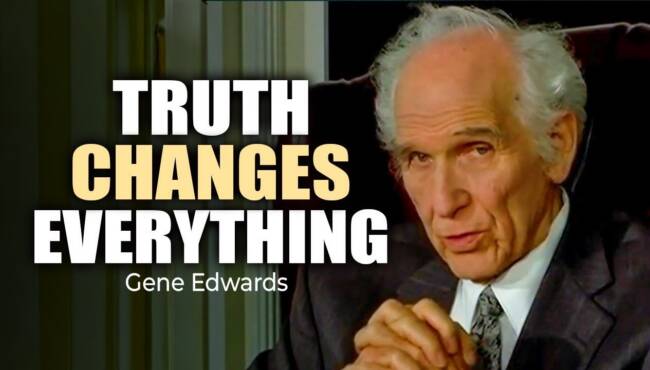
Truth Changes Everything • Jan 01, 2014


Your Traditions are Pagan • Jul 04th 1987
Could the traditions you hold most sacred actually be blocking your freedom? Gene Edwards argues that new archaeological evidence, much of it surfacing only recently, is finally “cracking” the prevalent religious mindset concerning the first centuries of the faith. He reveals how the early believers (100–313 AD) were “matrix neutral,” successfully resisting pagan influence without inverting into a rigid, formalized religious system. This new history challenges us by showing a classless community meeting freely in homes, where documents show “virtually no reference to any kind of clergy” and Jesus was invariably depicted as “smiling” and triumphant. Instead of solemnity and ritual, Gene Edwards shows that the Lord’s Supper was a “joyful festivity”. Gene Edwards calls for honesty and conscience, challenging listeners to embrace the total liberation found in confronting our deeply held, often unexamined, traditions and our “venerated Protestant history”.
I was in the jungles of Thailand. I went out there and found a group of Christians who had been led to the Lord by a missionary 50 years ago. He had left. Nobody had seen those people. They had been forced out of the jungles after the collapse of Vietnam. They were in a refugee camp. I was one of the first people in our time to lay eyes on them. They had not been seen. They were a tribe of Christians. They were Hmong. I walked into this refugee camp. I am trying to talk to you about a matrix and a mindset that holds us all. I walked into that place. They had not seen Christians from the outside in two generations, but sitting in the middle of that plastic refugee camp was one building about three feet higher than any other hut. I walked into it and there, made out of bamboo sticks, were these little things in a row for everybody to sit down on. And in the front, made of bamboo, was a little pulpit, and those people met at 11 a.m. on Sunday morning. Your mind and my mind have been caught in this matrix unknowingly and unwittingly, and if ever that revolution and that total restoration is to come, brothers and sisters, those things must be cracked wide open.
Now, I ask you, as the waters get rougher these afternoons, that you start bringing these things to the Lord. I don’t think there’s one of us here, but we need to be a little bit liberated from our own present-day matrix and from a vast, long, and too venerable Protestant history. I forgot the questions this afternoon. We’ll pick some up tomorrow. Is there anything you have to ask? Is anybody just dying to ask something? Did I misquote anything that needs correction here? Tomorrow we’re going to discover what second, third, and fourth-century Christians were really like.
That had been put on these people for the last 400 years; what is called the Roman school of archaeology has been a very religious, liturgy-oriented, strongly ecclesiastical, very much under the bishops. The Roman School of Archaeology had to bridge a gap from, let’s start with, the 19th century. They know what they are from there back to Constantine. From there, they leap over to the first century and interpret the Scripture in the light of those 1700 years. Now they have to make the second and third centuries match with the fourth and fifth, and so on. They have to make them match or their interpretation of the first century will fold. Are you following me? Everything pivots around Constantine. There is no doubt that the church took a nosedive after Emperor Constantine came to the throne. No question, no contest. The question is, was there a Roman Catholic established orthodoxy previous to that? Was there an unbroken line of what is from here to here, also going that way? If so, then we who are evangelicals and especially those of us outside the religious system are in big trouble. All their interpretations of those 200, 230 years are toward an extremely religious, pious group of people, very ritual-oriented, very Roman Catholic, and that they gave Constantine the torch, and everything after that is justified on the basis of second- and third-century Christianity.
When this building was excavated in Duro Europa, it literally reignited interest in church archaeology rather than biblical archaeology. Archaeology outside of Palestine. Archaeology outside of the Holy Lands. In this case, two places, not archaeology, not in the Bible lands, and not in Rome, but to begin looking everywhere else for evidence that will help unlock the door. What were second and third-century Christians like? Yesterday, I used the term “matrix neutral.” It may not be a totally accurate term; I made that up on the spot. I was asked, ” You mean the Christians of the first century in Jerusalem and Judea were not affected by their culture?” Of course they were. They were Jewish Christians, and there was a strong Judean heritage. But let’s get out in some little bitty obscure town that no one ever heard of, 150 years later, when someone comes through and preaches the Gospel about who is a gentile and what happens the next 50 years in his little world. Is he being greatly affected by the pagan society around him, and is his Christian faith being paganized? Or is he becoming inverted into a ghetto Christianity that is extremely religious, overly pious, with a world of its own vocabulary and its own creation? And in both cases, the answer is, gloriously, no. They are not being greatly affected by their pagan surroundings. Neither are they becoming an inverted religious…I don’t only use the word monastic, but ghettoized, a ghetto type movement…and they have, and they did greatly and successfully resist those two pressures. Now, then, can you prove that, Gene?
From the literature, you are virtually locked out, as the only written literature during this period is by men who were philosophers converted to Christ. They come in with their dialectical mind, look at the Scripture, and begin defending their view of the Scripture or Christianity to a pagan friend, or write a tract defending Christianity. There is nothing in that literature that lets us know what church life was like after 100 AD, from 100 AD to 313 AD. So, it has taken the shovel to give us a really clear understanding of what went on during this silent era, and it has been called the silent era many times throughout the centuries. Now, is that era going to stand with the ritual and so forth of the Roman Catholic Church? Is it going to stand with the Baptists and the Presbyterians? Or is there an outside chance, for the first time ever, that we who are outside the religious system will get a shot at historical acceptance?
Let me explain to you why this is very important. In case you don’t know it, you are not considered part of the great heritage of historical Christianity. You are in the term given to us by the British; you are dissenters. You’re rebels and troublemakers. You’re gripers and complainers. You’re out here, unhappy with church on Sunday morning. You don’t like Baptist preachers, and so forth. We’re out here seeking to establish a testimony based on what we see in holy Scripture given and delivered to us in the first century, and that’s all we’ve got other than a long but very small line of faithful Christians throughout church history. And we can hardly pick up their testimony before 380 AD. There’s still that silent era in there. It’s a thin line from 380 AD with Priscillian, all the way forward to, say, the Moravians. It’s a thin, small line. You can almost not find it at times. What do the second and third-century Christians tell us? We cannot look to literature for help. We have to look at the shovel and what comes out of it.
Now, is it really possible for artifacts, art, frescoes, and a couple of other words in here I cannot even pronounce, graffiti, and other things like that to really tell us anything? And the answer is, it’s incredible what they can tell us. And not only that, but with the recent shoveling that’s been going on in certain places and with the advent of the computer, there is an absolute deluge of new information coming to us. Let me get off the subject here for just a minute. Forget church history for a moment. The archaeologists of our day have turned to the computer, feeding in all sorts of information and coming out with all kinds of new information. They will perhaps find, on a papyrus, certain ships going to certain places and what they’ve got on those ships, and they’ll take that information and feed it into ship schedules and some information written by captains. They will find out how much corn was sold for in Pompeii on a certain day. Combine that with a census of the population of a city somewhere in Carthage, and they punch a lot of buttons. They come out with a total and complete schedule of ships sailing dates across the Mediterranean, what they’re carrying, and how much they’re carrying.
Now, with these same incredible approaches, they’re beginning to estimate the populations of certain cities at any given time and grasp their growth or decline. At the same time, for the first time, they are performing incredible calculations and telling us what the Christian population was in the second, third, or fourth century, and the results are very surprising. I’ve always read that the Christian family, probably at the time of Constantine, was around 5%. I think the information will ultimately go down. It’s going to be more like 2-3%. The Christian church was not as large as we thought, and it didn’t grow as great as we were always told it did. That’s wonderful; believe me, trust me, that’s wonderful. She was still a beautiful thing to behold right up until about 300 AD. Now, then, I think as far as I’m concerned, there’s only one bulwark left in the other interpretation of second and third century Christianity, and that’s all built around one word: bishop, and they’ve still got us in a corner with that one.
I’m going to close this meeting today by talking about the one great citadel they’re still waving over our heads. Bishops, bishops, bishops, all these bishops that we’ve heard about all of our lives. And I’m going to take that one on last. I’m less prepared to do that than with anything else, but I’m going to make some guesswork as to what’s going to come out in the next 15 or 20 years if the Lord tarries. I’m going to tell you again, I feel very inadequate. I’m not an archaeologist. I am not a historian, but I have been very lucky and have read an awful lot. Now, let me see if I can do this. Can you imagine someone picking up art coloring and then going to draw something? He unwittingly draws according to his culture, his thinking, and his age. Can you appreciate that? He does not draw a spaceship or the surface of the moon, right? Because he doesn’t understand those things. And when you and I do artwork, we don’t usually do tunics, sandals, and chariots, but rather automobiles and airplanes, because that’s where we are.
Well, the reflection of our thinking, our feelings, and our emotions is put into what we write, what we say, and what we think in every age. Now, I’m going to try to take one more stab at this. There seems to be no Christian anything from 100 AD to 180 AD, which simply means that a Christian culture and a religious atmosphere had not yet settled in. That can be pushed back to 160. It can be brought up to around 190. But just be grateful. If you could only understand the interpretation of that age, those people should have been calling their revered heroes saints. They should have been building and creating paintings simply honoring a pope. And they haven’t even gotten into their literature, such a term as brother. Now, that’s good; from your viewpoint, that’s good. Don’t look at me like that.
Okay, I’m going to try again. I’m going to start with what to me is just about the most important thing of all: any and all works of art or anything that symbolizes the Lord Jesus Christ. You know what a fresco is, or do you know what the two-dimensional things were? They hatched out on the side, hacked out of the side of the tombstones, little two-and-a-half-dimensional figures. A painting of the Lord, a painting of the Lord, and whatever group is around him. Now, a lot of this stuff was misinterpreted 400 years ago. Today, when this thing has become an exact science and is compared with the thinking of the secular art of that day, these artifacts can be pinpointed to within 20 or 25 years of when they were done. Boy, a whole new concept of what second-century Christians saw of the Lord Jesus Christ emerges.
I’m sorry to those of you doing the video, but I can’t stand still any longer. Oh, shoot. Alright, I get excited about this. There ought to be, within these artifacts, and I’m going to use the word artifacts to cover it all. Everything that would in any way depict the Lord Jesus Christ, there ought to be things there that would show doctrinal orientation. There should be evidence, things that show an ecclesiastical orientation. There should be things there that speak of judgment and eschatology and all sorts of things that we, as Christians, after the third century, came to understand and have woven into the warp and woof of our thinking. None of it is there – none of it. What emerges is quite incredible. What you see, and the first thing that strikes you, is He’s young. The second thing is that He is always swift. This means he is moving. He is itinerant. Now then, it is impossible for anyone to depict that without their having that kind of understanding of the Christian faith that there will be this maybe it’s a mosaic maybe it’s something on the side of a tomb two three four fixtures he’s always moving it’s graphic it’s living, he’s in one place another place and he’s on the move to yet some other place they are reflecting their understanding of a Christian leader. He is itinerant.
Truth Changes Everything • Jan 01, 2014

Free to Fellowship with Christ • Dec 07, 2013

Sow to the Spirit • Nov 23, 2013