
When the World Calls You Evil for Loving Christ • Nov 22, 2025

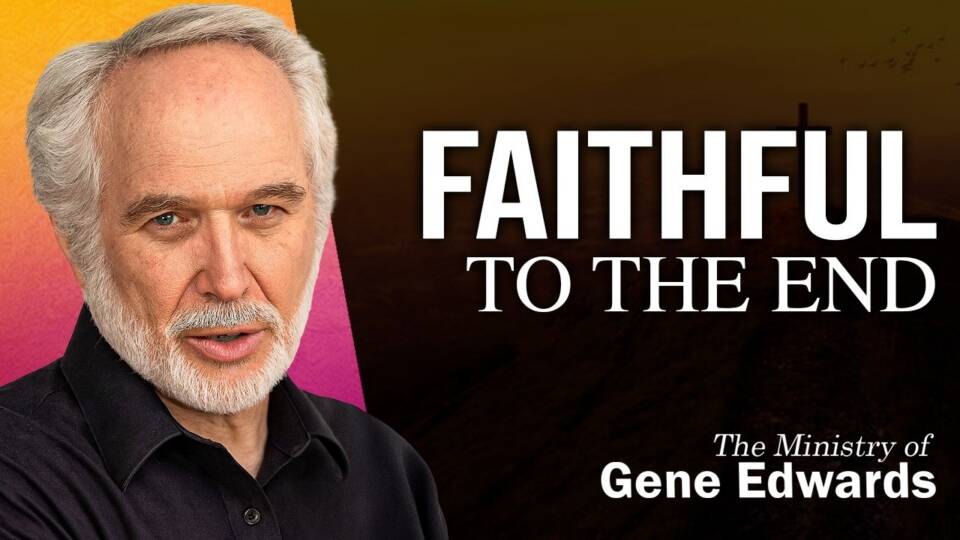
Faithful to the End • Nov 01st 2005
What happens when a Christian movement ends? Does anything remain that continues to impact God’s people for generations?
In this fascinating discussion, Gene Edwards explores some of the most influential Christian movements in church history—including the Moravians, Anabaptists, Waldensians, Quakers, Watchman Nee’s Local Church movement, T. Austin-Sparks, and the Jesus Movement. Through their stories, he asks a profound question: What lasting contribution does a movement leave behind when its work is finished?
This message examines Christian history, discipleship, revival movements, house churches, missions, baptism, spiritual growth, the centrality of Jesus Christ, and God’s eternal purpose. You’ll discover how believers throughout history remained faithful in times of persecution, restored lost truths, and sought to follow Christ beyond religious tradition.
Whether you’re interested in Bible study, church history, Christian living, spiritual formation, or understanding God’s purpose for His people, this message offers valuable insight into what truly endures in the Kingdom of God.
Topics covered include:
• The Moravian contribution to modern missions
• The Anabaptists and believer’s baptism
• Watchman Nee and the testimony of faithfulness
• T. Austin-Sparks and God’s eternal purpose
• The Jesus Movement of the 1970s
• House churches and New Testament Christianity
• The centrality of Jesus Christ in the Christian life
• What makes a spiritual work endure
As believers, we must ask ourselves: If our generation does not finish the task, what testimony will remain for those who come after us?
By the way, T. Austin Sparks is living proof that you can preach people into righteousness, holiness, and piety. T. Austin Sparks held forth at Honor Oak for, I guess, 50 years. They came into the meeting, and he spoke, and he spoke on the church, and they all went home. He spoke on Christ, and they all went home. He was a total 100% theoretician, but he had a really beautiful people. After he died, there are now two of them left alive. Honor Oak is now owned by… a big movement started in South America. It’s big, like Campus Crusade. No, it’s different from that. Operation Mobilization now has the building, and at least until recently, two little ladies came down there one evening and prayed together for the Lord’s work. But when he died, his work died within seven years…just like it’s going to be with me. Yes. I think we could say one thing. There was a thought he gave us, blessed all of us, and that was, gosh, how do you say this? He had a little chart showing that God was moving toward His eternal purpose. He was a man who was very strong on this, to whom we all are indebted. And then he had a little line down like this, and he showed the cross. He said, “The cross is the detour back to the eternal purpose.”
Now, you take somebody like Frontiers Missions or Youth with a Mission, and the Baptists, we go up to here, and then we come down to the cross, and that’s where we stay forever. We went to seed, forgive me, on redemption and salvation, when in fact salvation was a detour in God’s eternal purpose. So, he spoke a great deal on the eternal purpose of God, and I would tell you that I’d hate to think of us being armed today without the ministry of T. Austin Sparks. But as far as a group of people being a testimony, it never happened. But I do really appreciate these questions. I want to see all this clarified. Anybody got another question?
Audience: We could give him credit for originating the centrality of Jesus?
Why not? In that respect, he greatly affected the life of Watchman Nee. I don’t know if you realize how much influence T. Austin Sparks had on Watchman Nee. I’m trying to think of anybody who went straight for Jesus Christ and didn’t vary in any of these testimonies. I guess that’s the first person who walks across the pages. Most of the time, when T. Austin Sparks got up to speak, he spoke about the Lord Jesus.
Here was the Lord’s work going on in Great Britain, and there was the Oxford Movement. And there was work among the Anabaptists and some others… the Pietists. They didn’t have the courage to step in, and they weren’t quite out. And Francis Schaefer…I’m not supposed to speak anything ill of Francis Schaefer… and I won’t. But he was sitting right over there on the edge…an intellectual. They’re doing nothing in the world but giving dead encouragement to people who ought to be outside institutionalism. Now y’all didn’t know I had any convictions about this.
The Jesus movement…that was a work of God. That was a work of God; that was a blowing of His Spirit. It came out of nowhere; it had no leaders whatsoever. On January 1st of 1970, I made the statement, “This is the blowing of God. It’s the first time in all of American history that there have been Christians leaving the institutional church.” But…watch this. Men my age…this is what I said in 1970…Men my age…which was at that time 36…who were saved in the last revival of 1950, came on over and got educated, taught, and so on. And they didn’t become great leaders, but they flunked. They will step into this situation today, take over, and destroy what’s going on. Now, I’m not a prophet, and I’m sure not the son of a prophet, but that is exactly what happened. If you’d been familiar with history, you could have called it like a shot. And I was one of those people who got saved around 1950. I was in that revival, but I’m the only one who didn’t get in there and teach John Darby. I’m the only one who didn’t say we got to do this because Jesus is coming, and I didn’t say that this is the last work of God. I didn’t say to them, You have to get into the Bible, or Jesus won’t like you.” And I believe I am correct that Smith, what’s his first name? Calvary Chapel. Chuck Smith’s work is the only thing that survives that was born in that movement. None of those men exist now, nor do their works. Not one. I dare you to name one born during the Jesus revival. Anybody other than Chuck Smith?
Audience: Your work was born then, and it is still surviving. And there are many people in the Jesus movement who are from your work.
Oh, absolutely. A whole slew of them. In fact, the last I heard about that group, they had taken a name that had nothing to do with the Jesus movement, and I don’t need to tell you what…we’ll talk about it after the meeting. I only know it as a name, and only as a cult. I was thinking more like all the other groups. Now, in case someone says the Vineyard, the Vineyard was not born during that time, but I’m going to tell you something. It did come from Chuck, but it came afterward. There’s a group of people to be dealt with. Everybody who leaves the church joins the Vineyard. And I’m impressed. So, when you leave here, folks, go join the Vineyard…and don’t tell me I’m not ecumenical.
Audience: Two questions. First, you mentioned last night about Ray Stedman’s Body Life. And my first question is, how on earth did that book become so popular when it didn’t seem to change institution-anything?
Just exactly like everything else down here at the bookstore. He was a theorist. Somebody else wrote another one very similar that was popular. To them, the fact was that when he started his Sunday morning church meeting, he’d sit down in a chair before he reached the pulpit and ask if anyone had anything they wanted to say. He wrote a book on it that had a powerful impact, and the name of the body life, I believe, was something peninsula, and that thing, yeah, they’ve never known body life, and you never will know it in its institutional church.
No, listen. I’m going to drop all this because I’m not an authority on the institutional church.
Yeah, I would say it started with Dwight L. Moody, and it grew out of the YMCA and Moody Bible Institute. It was a Plymouth Brethren concept that the church was no longer useful, and we still brandished the word church around, and it’s a church that’s out in the ectoplasm. It’s an “amorphous” church, and it’s the world’s largest denomination. The amorphous church for years and years now. I didn’t mean to get this involved, but I think I see a hand.
When the World Calls You Evil for Loving Christ • Nov 22, 2025
This Is How You Must Honor The Son • Nov 22, 2025
See How Christ Lived • Nov 22, 2025