Stop Playing Church • Feb 18, 2026

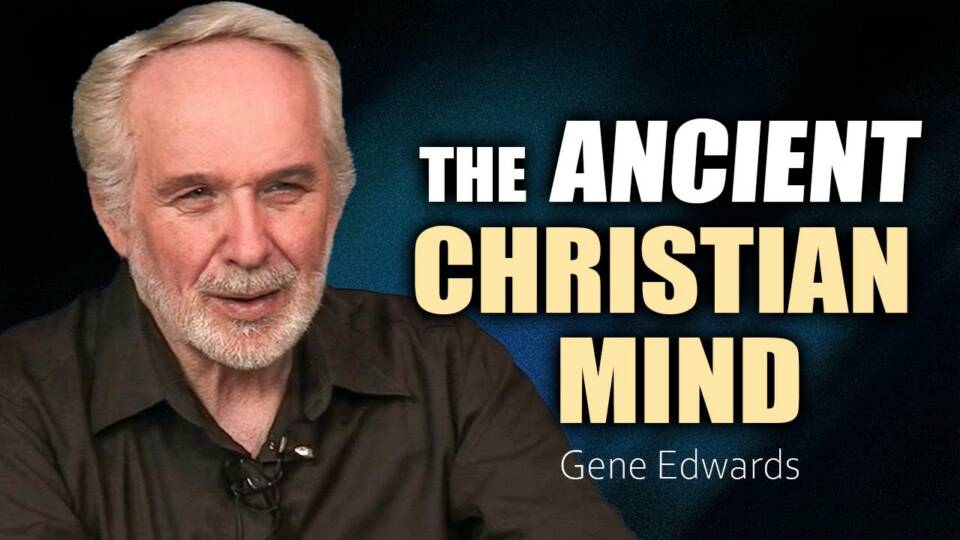
The Ancient Christian Mind • Jul 04th 1987
In this powerful Church History Conference message, Gene Edwards explores a radical and deeply spiritual truth: the Christian mind did not begin with man—it began in God before creation itself.
Drawing from Colossians 2:9–10 and 1 John 1:1–3, this teaching challenges believers to rethink the foundation of the Christian life. Our problem, he argues, is not lack of knowledge, theology, or information. The problem is our mindset—specifically, the Western, Aristotelian mindset that has shaped Christianity for centuries.
Edwards contrasts the Western analytical mind with what he calls the Christian mind—a mind that originates in the eternal fellowship of the Father and the Son. The mind of Christ is not native to this planet. It is not native to human intellect. It is spiritual, ancient, and rooted in the eternal fellowship of the Godhead.
According to this message:
The Christian life cannot be lived by human effort.
The Christian mind cannot be grasped through reasoning or debate.
Restoration of the church begins not with structures or methods—but with fellowship.
Jesus Himself lived by this eternal fellowship. “Without My Father I can do nothing.” And to us He says, “Without Me you can do nothing.” The Christian mind is passed on through indwelling life—Christ in you.
This message also addresses:
Why Protestantism struggles with restoration
The difference between intellectual theology and experiential faith
The loss of the early church’s language of “in Christ” and “in God”
The danger of rationalizing spiritual realities
The call to young men and women to carry the torch of testimony
Edwards ultimately brings the focus back to simplicity: a living, experiential encounter with Christ. The restoration of the church begins with recovering fellowship—first with the Lord, then corporately with one another.
This is not a message about religious reform. It is a message about spiritual recovery.
The Christian mind is older than creation—and it is found only in Christ.
I want to say something here. I want to be very, very personal because I’m about to publicly disagree with Lance on something, and I know he doesn’t mind. I’m sure, Lance, you don’t mind, do you? You just couldn’t. And it is not what I’m about to introduce. Last night, I found out, of course, that brother Lance is premillennial, and everybody I know is premillennial. The only person I know comes out of an amillennial background. The only Christian worker I know outside of the religious system of an amillennial background, and the only one outside of captivity, is me. And now, Lance, we are going to make a covenant. When the Lord comes, you can look for me, and we will watch one another, and we will call for one another. And if it’s a general thing and we’re all caught up, I will holler to you. See there, Lance? I told you so. But if Lance is correct, if it is only for those who are prepared, and he is premillennial and I am not, I fear it’s not going to go that way with me. I’m afraid he’s going to be sailing through the air and look down and say, “Aha, Gene, I told you so.”
I don’t disagree with Lance on the next subject. I just want to not believe. I know that everything in church history says 50 years, and that’s it. Two generations, three at the most, and it’s got to all be done over again. Okay. I wish to say, Lance, all history is with you, and you have every right to believe that. I have hope. I’m a born optimist; I have hope. But I’d like to broaden this thing and look at it and say, you know, I remember 30 years ago there was one health food store in the state of Texas. Now there’s one in every village in America. It doesn’t matter whether you believe in healthy food or not. That’s not my point. They made progress, no matter what you think of it; I’ve just observed that. It might be that we will be able to make a statement someday that will cause a greater general seedbed for the Lord’s work to go forth. Not one movement, I wouldn’t trust one movement to last 30 years, but a broadened seedbed in which the Lord’s work can go on better in many places and in many ways. I am discussing the destruction of the Protestant mind. Oh boy, wouldn’t that be nice? The Protestant way of processing information.
Now, brothers and sisters, as we have looked at these dear brothers and sisters who come before us, who laid hold of Jesus Christ, now we must ask ourselves, “From where shall we go forward from here?” And I’m going to come back once more to what one of our brothers said to us yesterday. It begins with Christ, and it ends with Christ.
One of the advantages, I don’t recommend, of being in bed all the time is that you don’t have anything else to do. You write, and I’ve got a manuscript that will never be published. It’s about 600 pages long. I guess that’s about it, it’s about that thick. It is tentatively and poorly entitled “In Quest of the Christian Mind.” If it were ever finished, it would be about that big. Whatever happened to the Christian mind, and what happened that caused us to lose it, and how shall we regain it? I could spend six weeks talking to you about the Western mind. I really wish you understood it and came to despise it, its origins, and what it does to us as Christians and believers. We could talk for hours about the Protestant mind and how it processes, and it is so far afield from the Christian mind.
Now hold on to that word, “the Christian mind,” for a moment. That’s the term I’m going to talk to you about from this point on. It is here that we begin the matter of talking about practical recovery. The recovery, the restoration of the Christian mind. Lay hold of that and let the Christian mind begin to saturate you. You will not open the Scripture and find a choir, a seminary, a building, and all those things. Something totally different will happen to you, and it will not be an intellectual apprehension. To me, the first thing on the agenda is the restoration of the Christian mind. It comes first. It’s foremost. It’s above all else. I repeat, we begin with Christ, and we end with Christ.
Now, brothers and sisters, I think from this moment on, I will totally lose you, but I have to start somewhere. I’m going to talk about things that you probably never in your life ever could have conceived or thought of. Let’s talk about where the Christian mind originated. Paul is speaking of all these glorious things. There’s Peter – read his epistles. Speaking of things, their vocabulary is unlike anything that came before or after them. One of the interesting things about the earliest Christian literature that is beyond the first century is that the words “in Christ” and “in God” have disappeared: this mysterious thing that seemed to saturate them. Being in spirit, walking in spirit, being in God, being in Christ, disappeared from Christian literature. They were losing the Christian mind rapidly. This incredible mystery that they flung around right and left and never even bothered to define for us: “in God”, “in Christ”, “in me”, “in Him”, “in you”; being possessor of all spiritual riches in the other realm. What on earth did he mean? What could that mean to me, speaking today or living today?
Mysteries. Where does this all come from? You tell me. I’m going to ask you. From whence comes the Christian mind? Say it really loudly. I’ll repeat it here. Let’s hear it. Where did the Christian mind originate? In Christ. In God. Do you have anything else? Those are two pretty good answers. One’s right, one’s wrong…and now here we go.
The Christian mind did not originate with Jesus Christ. Write this down if you’re taking notes. The Christian life is not native to our planet. The Christian mind is not native to our species. The Christian mind is more ancient than this planet. The Christian mind is more ancient than creation.
Now I’m going to add one. I’m going to throw this in free; it’s got nothing to do with it. You cannot live the Christian life because it is not native to this planet, and cannot be lived on this planet. Hold on to your hats. Don’t faint. It is not native to our species, and furthermore, Jesus Christ could not live the Christian life. He could not live the Christian life. That’s what He said. I’m quoting Him now. The first Christian this planet ever saw said, “Without my Father, I can do nothing.” And then He looked down at me, and He looked down at you, and He said, “Without Me, you can do nothing.” The Christian mind is ancient. Oh, so ancient. The Christian mind is found only in God the Father. That’s where the Christian mind came from, and if it’s ever to be laid hold of, it will be laid hold of within the Godhead. Well, that leaves us in pretty short supply, does it not?
I want to tell you how the Christian mind came to be on our planet. There was God, and there wasn’t anything else. Then He made the heavens, or the other realm, the spiritual realm, to match Himself, and He entered the realm in which He created. But it was first in Him. The spirituals, the heavenlies, were in Him. He was the All, and then He put eternity, the eternal realms, the spiritual realms in Him. Then He entered His own creation, dwelt in the spiritual realms, and there He lived the Christian life. And there He thought, or whatever He does, He doesn’t think. He apprehends, intuitates, and revelates. That’s what He does, there in heavenly places. Now, do you know how long He did that? Tell me how long He did that. A few days. How long did He do that? Eternity. If we can use this term, eternity past. Who was in Him? The eternal Son was in Him, and the eternal Son gained from the eternal Father the Christian mind. And by means of the Father, the Son lived the Christian life. Now, I told you this would all be new vocabulary to you. You think you’re following me?
One day, the Christian life has been living all this ancient time by divine life, by God, by eternal life out there in past eternity in a spiritual realm. I’m going to repeat myself. The Christian mind is only in the spiritual realm. It’s not anywhere else. It’s in the spirituals. God is spirit, and He dwells among those things that are spiritual. One day, He decided to bring the Christian mind to this planet, and He did through a door from one realm, the invisible spiritual non-material realm, into the physical visible material realm through a portal. He came. The portal was Mary’s womb.
The Christian mind, ancient as it was, and the Christian life, now entered our realm. Ancient, rich in heritage, rich in the thought patterns…that’s not a good term…of God, and God’s perception and God’s revelation and God’s apprehension of things, and He grew up in a Jewish home. Now brothers, without taking away any of the influence of the culture around Him, His Jewish culture, nonetheless, when I read men talking about the inspiration of the word of God, and this and that and the other, and the Bible being infallible and all that, which I agree with, and then they will say, “Now, the reason Jesus Christ did this was because it was a Jewish custom of His day.” He’s talking about spiritual things, and the Lord did this because He was a Jew. For instance, the way He trained His 12 apostles: this was an oriental approach to training disciples. Baloney.
Stop Playing Church • Feb 18, 2026
Escape Religious Cage • Jan 10, 2026
Break the Dead Chains • Jan 10, 2026