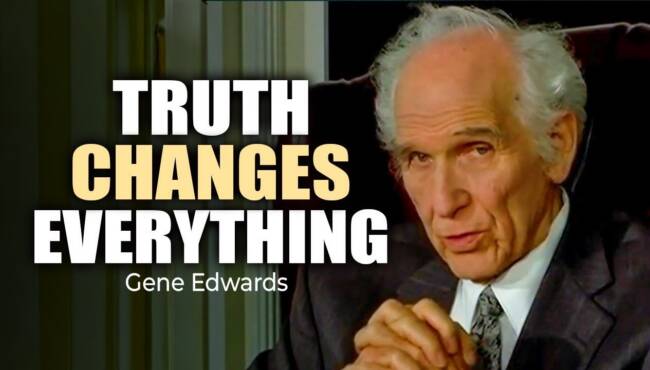
Truth Changes Everything • Jan 01, 2014


Why Paul Kept Going • Jun 01st 2007
What is a Christian’s comfort zone, and what happens when following Christ pushes us far beyond it?
In this powerful and unfiltered teaching, Gene Edwards walks through the life of the Apostle Paul to expose a reality often ignored in modern Christianity: true discipleship frequently carries suffering, injustice, misunderstanding, and endurance beyond human limits.
Using parallel accounts from Acts 18 and Acts 19, Gene shows how Paul’s ministry repeatedly left chaos in its wake—not because of sin or error, but because the gospel collides with systems, religion, and human comfort. Innocent bystanders are beaten. Friends are dragged into violence. And Paul himself absorbs unimaginable punishment, yet continues forward without bitterness.
This message traces Paul’s life chronologically—from Damascus to Jerusalem, Antioch, Cyprus, Galatia, Philippi, Thessalonica, Corinth, Ephesus, and finally Rome—revealing a man whose stress tolerance and endurance were radically different from ordinary believers. Paul had what Gene calls an almost infinite comfort zone, forged by God long before his conversion.
But this teaching is not a call to imitate Paul’s extremes.
Instead, it brings freedom.
Gene explains that God does not expect every believer to live like Paul of Tarsus. Each Christian has a unique endurance level and stress capacity, designed by God Himself. The danger comes when believers judge one another—or try to force themselves or others into roles God never intended.
This message is especially relevant for those who have stepped outside the institutional church, those who have been wounded by church conflict, splits, or religious pressure, and those who have struggled with bitterness after injustice. Gene speaks candidly about church divisions, persecution, failure, and why enduring hardship can become a place of spiritual growth rather than disillusionment.
Ultimately, The Christian and His Comfort Zone (Part 1) asks hard questions:
This is Part 1 of a two-part message that challenges believers to rethink comfort, endurance, and what it truly means to follow Christ in a broken world.
Okay, I want to speak, not to you, but to a large number of people. For those of you who will turn this on someday and listen to it, I am in Greater Atlanta, in a small town just outside of Atlanta. I think we’re south of the west of the city. It’s a place called Lithia Springs…Stone Springs. And there’s a small group of bold, brave, foolish Christians in the room with me. But this is not a message just for Lithia Springs. I’m hoping that anybody who ever steps out of the institutional church will one day hear this.
I’m going to read two passages of scripture to you: the kind of scriptures you would pass over and think nothing of. One of them is in Acts 18. The other one is in Acts 19, and you will find that they are very, very similar in their context. So, here’s the 18th one. It is 18:17, and the background is Paul’s last days in the city of Corinth. He was there 18 months, and just as he was about to leave, there was a great stir in the city. Some really angry people went out to find Paul to beat him. Well, I don’t know where Paul was, but he wasn’t where he should have been. At least they knew where he was supposed to be, and he wasn’t there. And this is what happened as a result. Then they seized, all of them seized Sosthenes, the leader of the synagogue, and they beat him.
Here’s chapter 19. This is 19:28-29, “When they heard this, they were filled with rage and began to cry out, ‘Great is Artemis of the Ephesians.’” Now, this is also the last day Paul is in Ephesus. The other is the last day he is in Corinth. He had a way of leaving town, always in trouble. So, the last church that he started in Corinth, well, anyway, let’s see the story that we’re reading here would be around 19, the year 51, 52, 53, 54, 55, and then this one would be in 58, and it ends the same way, and here it is. So, the city was filled with confusion, and they rushed all together into the amphitheater, and they dragged in Gaius and Aristarchus, Macedonians who were with Paul and his traveling companions. Paul wanted to go in, but his friends stopped him. Could you imagine what the point is? I want you to listen. We’re going to talk about this for about an hour and a half. The point is, this is what happens to dear innocent people; they are nothing but bystanders. This is what happens to innocent and uninvolved people. This is what happens to those who run around with church planters. One of them got beaten, and the other two got dragged into the amphitheater in Ephesus…dragged in. They had absolutely nothing to do with the way they were mistreated. These were people out looking for Paul and taking their fury out on somebody who was a bystander.
The first thing I want to do is make a simple statement to you and to everybody who listens to this. The heart of man is desperately wicked, and it hasn’t changed in our day. Unethical things are happening constantly. There is no way in this world to prevent it. Being a nice, sweet Christian doesn’t help the situation one bit. Unethical, unjust. It’s abroad in the land. It’s in our bloodstream. It’s who man is.
Now, I’m going to start in the Old Testament and do this really quickly. Abraham had to gather a group and raise a small army to stand against some folks to free one of his kinfolk. Isaac had married a young lady, but had to work for seven years before he could marry her, and that was to his own uncle Laban, and this was just good Hebrew practice. He was, for all practical purposes, made a slave. David is turned into not much more than an animal when Saul, jealous of him, begins trying to hunt him down and kill him like a dog. We come to the prophets, and we find Jeremiah in a pit. I always figured he was up to about here in mud, the pit of the miry clay. They threw him in there, and he had nothing to do but stand there in the mud. What is hard for us to really identify with is that all this stuff gets romanticized, right up until it enters your life. John the Baptist had his head cut off with jealousy. Even when Jesus first began His ministry, a group of Pharisees and Sadducees came out into the wilderness. Saints, this is so typical. This is not just something in the Old Testament or the New Testament; it’s right here, right now. Let’s see what’s the latest thing going on, and then the religious people come to inspect it. When they did this with John, he called them a bunch of vipers. When Jesus began, He was under the scrutiny of those in charge of religion.
Peter is about to be beheaded. James has already been… It’s Easter… we’d call it an Easter festival… by one of Herod the Great’s sons, and he is pleasing the Jews. He’s going to have Peter’s head chopped off the next day. The church is praying, God love them. Peter is sound asleep. I guess he’s learned a little bit from his Lord, who was himself crucified on a cross just recently. This is where this kind of man ends up. Peter was asleep. Now, when all of us read these stories, we immediately identify with them, but I guess really, we shouldn’t. It was just Peter in that prison, asleep. There were thousands of Christians that night, both afraid and praying, but only Simon Peter was in trouble, and he was asleep.
Now, I’m going to use a term that will go on throughout the rest of this message. Peter obviously had a comfort zone that most of us could never obtain. He was sound asleep just before he was going to get his head chopped off. I think we could all agree that most of us would be awake that night, wouldn’t we? So, I’m going to say this to all of you. Where is your comfort zone? Some of us have a very low comfort zone, and when it gets violated, we’re uncomfortable. Keep that in mind. Our endurance level. How much can we endure? We’re going to look at Paul and find out that we have just so much that we can endure. We have a scale. You endure that much. We get to that point, and that’s it. Then there’s the stress level. The endurance and the stress level…how much stress can we bear before we have to stop and bail out? I want to go through Paul’s life now.
About 47 years ago, I was a young minister, and I did something that I don’t know why nobody else ever thought of, but it sure did get me a lot of trouble. I decided to read Paul’s life through his letters, in the order he wrote them. So, I was reading his letters in the order he wrote them, not the way they’re in your Bible, and I began to realize, my goodness, some of those letters got written right in the middle of the book of Acts, where you could turn to a verse and say right there is where Paul wrote a letter. The first one is Acts 15:40. You write a little note. Now Luke didn’t leave a little note and say, “By the way, right about here, Paul wrote a letter,” because Paul didn’t even know those letters he was writing would ever be called part of the New Testament. But right there is the first letter he ever wrote, the first letter ever written, the first piece of Christian literature ever written, and this goes on through Paul’s life. When you begin reading his letters in the order they’re in, something happens that you can never get through Bible study. I don’t care who you are, what you know, because Paul’s letters are in absolute chaos. Total absolute jumble. They cannot be comprehended as a whole, but when you put them in their proper order, and then you get Luke helping you, the story emerges, and you can date the years. One of us here in this room, sitting over at that door, can even tell us what was happening in the Roman Empire in those particular years.
So, if we say that Paul wrote Galatians in Acts 15:40, that’s I’m sorry, that’s a verse of scripture, not a date. That’s in the spring of the year 50. We can ask our brother what was happening in the spring of 50, and he’ll be able to tell you right away what happened. So, you get even more context here, and all of this begins to move. Did you know that nobody living on the earth at that time knew that Paul was a great man? Barnabas would have never left Paul if he had known what great esteem he is looked upon today. I’m going to quote a statement. “He could not possibly be important because I know him.” Do you ever read stories about things that happen, and they ask the man, “Why did you let him through? Why did this happen? Why did you do something like this?” And his answer was, “Well, I never expected anything like this big to happen and be in my life.” So many things have been gotten away with in human history because the guard, the keeper, or whatever knew that he was nobody and therefore nothing could happen to him. Therefore, he was not expecting anything great to happen. Are you following what I’m saying?
Well, Paul is not a great man if you know him, because you and I are not expecting to ever have Paul in our lives. Paul of Tarsus must have had the worst reputation among Jewish Christians. He was out there with the Gentiles. First of all, he’s running around the uncircumcised, unclean heathen. What is that man? Where? Where did you say he went? He got up. He got beaten up there, didn’t he? And the sons are just like him. As soon as he got saved, Paul was beaten in Damascus, and he had never even done anything. The only thing he did was preach in a synagogue in Damascus. And Damascus, I’m sorry, the rulers of the synagogue had the right to beat people. They got hold of him, and they gave him a good beating. Well, a little bit later, they have him, the whole city is guarded, and they’re trying to catch him and kill him. You know the story you heard as a little child: he was let down in a basket and got away. He came down something called the Royal Highway to Jerusalem to try to meet Peter. He tried to meet the apostles, but they were all in hiding because persecution was underway in Jerusalem. Folks, these are not the kind of people you want to run around with. They’re born to trouble like the stark sparks fly upward. So, Paul gets into Jerusalem. He can’t see the apostles. They’re all in hiding. He meets Peter, James, and John for 15 days, but he’s not hiding. He’s not an apostle. So he goes over to the libertine, the free synagogue, the synagogue of free Jewish people who come there from the rest of the world and not Israel, and he begins preaching in that very synagogue where Stephen is stoned to death, and lo and behold, the brothers in Jerusalem have to sneak him out of the city because the folks in the synagogue want to kill him just like they did Stephen. He’s taken back home, and he disappears in Tarsus, way up the coastline. In fact, the coastline goes like this, and it curves like that. There’s Tarsus right at the curve.
He’s minding his own business when Barnabas shows up and says, “I would like for you to come down to Antioch. You told me that you’ve been called to preach the gospel to the Gentiles. Well, I got a bunch of them you can preach to.” So, he comes to Antioch with him. He’s there for several years; as far as we can tell, this dear brother lives in peace longer than at any other time in any time we know about him. He and Barnabas set out on their first church-planting journey. They leave Antioch, and they go to Cyprus. You will not find this in any history book, but it is an ancient legend of Cyprus that Paul went to the town of old Pathos. He preached in the synagogue, and the synagogue leaders grabbed him and beat him, stretched him out over a pillar, a broken pillar, and beat him. Now, he’s already been beaten once. He’s got…when we hear him speaking about these things that happened to him in the past in 2 Corinthians, we were missing one of the beatings. I don’t know where he got beaten, but the people in Cyprus, to this day, can take you to that pillar over which he was bent and beaten, they say. So, I’m going to buy into that and say, “Well, we don’t know anywhere else. It sounds reasonable.” That’s what the Cyprians believe. So, he’s just getting started on his journey, and he’s gotten beaten.
Truth Changes Everything • Jan 01, 2014

Free to Fellowship with Christ • Dec 07, 2013

Sow to the Spirit • Nov 23, 2013