
When the World Calls You Evil for Loving Christ • Nov 22, 2025

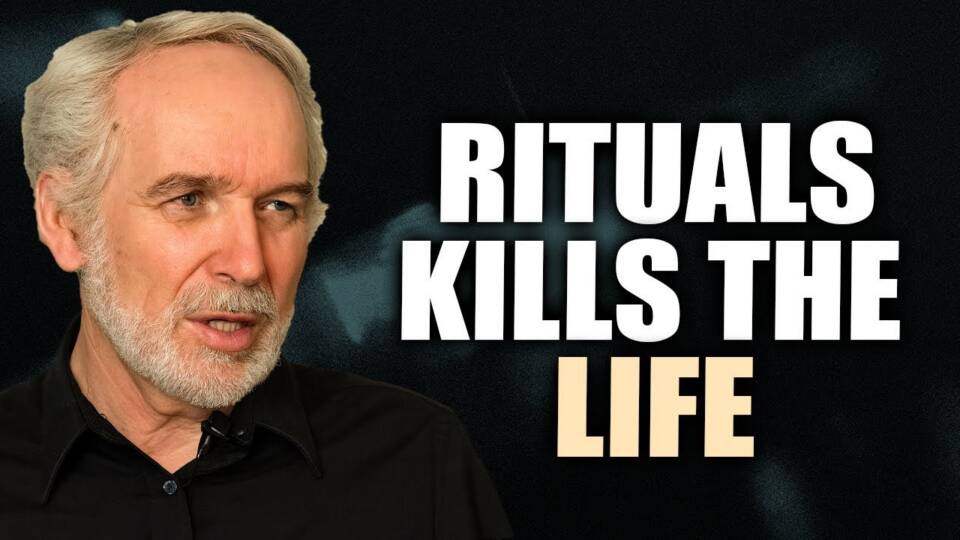
Rituals Kill the Life • Jul 16th 1988
How should Christians meet together, and what happens when church becomes more than a weekly service?
In this challenging and practical message, Gene Edwards explores a radically different approach to Christian gatherings, New Testament church life, fellowship, and experiencing Jesus Christ together. Rather than treating church as a meeting where a few people lead and everyone else listens, Edwards describes a church in which believers learn to know Christ, share Him with one another, build genuine community, and actively participate in the life of the Body of Christ.
Drawing from years of experience with churches and Christian communities, Edwards explains why preparation for a gathering may be more important than the gathering itself. He discusses meeting in homes, sharing meals, praying together, singing, giving testimonies, preparing believers to participate, celebrating the Lord’s Supper, and allowing church life to grow organically out of a daily relationship with Jesus Christ.
At the heart of the message is a simple but searching principle: Christians should not come together merely to receive. They should come prepared to give—to share something of Christ that has become real in their own lives.
Edwards also challenges traditions that can turn Christian gatherings into predictable routines. What happens when every meeting begins to look the same? Should a church continue meeting simply because that is what churches are expected to do? Could there be seasons for fellowship, meals, retreats, prayer, evangelism, testimony, singing—or even seasons when regularly scheduled meetings should stop?
This message from the series Needed: A New Way to Meet invites believers to reconsider what Christian fellowship and church life can look like when Jesus Christ Himself is the source.
Now, wherein does its strength lie? Wherein lies its secret? Now, you tell me. The motor is the Lord. Yeah, you want to elaborate on that? Do you want to say anything more than that? Do you understand that it is a meeting in which everybody gave? It was not a meeting where anybody came to get. When that begins to shift in the other direction, meetings begin to die, and that brings us up to another point, although I don’t want to leave that one, and that is, you’ve got to be prepared to do this kind of thing over and over and over forever. For as long as this church exists, you’ve got to do this again and again and again.
Talk to me about it for just a little bit. What themes will I speak on? I want to tell all of you listening to this message. All of you who consider yourselves ministers, please get off this business of getting up on Sunday morning, preaching a sermon on a subject, and then going next week on another subject. If you’re going to minister, minister for weeks and weeks and weeks on one subject, and don’t do that unless you know how to bring your people to the reality of what you’re speaking on. Give them things to do that make it practical and living in their own lives, or don’t touch it.
Well, what are those subjects? Well, I could stand here all night long and tell you what those subjects are. One of them is how to meet, and that’s good enough. There’s one right there. Needed a new way to meet. A revolutionary new way to meet. And by the way… I’ve only begun to touch this subject because, as far as I’m concerned, what I just said to you is only the tip of the iceberg. It’s only the very beginning. Let me tell you what you’re going to do. You’re always going to neglect that motor. You’ll think these meetings will go on like that without you touching the Lord. They will for a while, and you won’t even know what’s happening.
Now, that’s why glory churches lose their glory. That’s why super churches lose their super. Let me tell you something, saints. I have heard this said over and over and over again, and I really disagree. I’ve heard it said, it doesn’t matter if the Lord is with us and life is present. It doesn’t matter whether we have a form or a ritual or not. The Lord is greater than the form and the ritual. If His life is there, His life will flow out through any kind of form. That might be true for a few days anywhere on earth, but I want you to know that ritual and form destroy and kill life. Form and ritual, and habits destroy life. Neglecting the source of your faith, who is Jesus Christ, also destroys life.
I don’t think I have ever met a people who caught on to what I’ve just said. My only experience is I’ve come back every once in a while to remind them that they have a nose on their face, that we’re having problems now. Why are you having problems? Well, we don’t have enough teaching. Well, we’re having family problems. Some of the sisters are very discouraged; some of the brothers are having discussions and debates over so-and-so. Oh, in other words, you’ve stopped meeting with the Lord. It’s just that simple. Well, we’re doing some of that. Well, then it’s time you call me back in. That’s what a church planter does; he comes back in to remind you, nose on your face, that Jesus Christ is your all, your everything, and your hope.
You know, brothers and sisters, they have taken two or three verses on the Lord’s Supper and made whole institutional concepts out of it; it’s unbelievable what they have done with two or three or four verses about how a meeting should be conducted. It’s ridiculous. All meetings end, for instance, with a praise to the Father. That comes from a verse of Scripture, from Hebrews. I’ve got no fault with it, but my land has done it for 150 years: ending every Lord’s Supper meeting with a song of praise to the Father. This brings me back to what I was saying at the beginning. Don’t we have any imagination whatsoever? Can’t we harness it? Can’t we do something altogether different?
To have the Lord’s Supper properly, we should always risk getting drunk on it. How’s that for a beginning? You like that? I can back that up with Scripture, brother. I don’t think we should ever get drunk on it, but I think we should run the risk that it’s possible. Obviously, it was a very joyous occasion for the Corinthians. Poke holes in that. Just attack me on that. They were getting drunk at the Lord’s Supper. It’s in the New Testament. It’s right there. They were having food fights. I’ve been in one Lord’s Supper meeting where I was so glad it was grape juice. God’s people were having a ball.
I will tell you, I will make one suggestion for all of you, and that is that on Maundy Thursday or Good Friday next year, go to a restaurant and have the entire fellowship, the entire church, come together and have dinner together in a restaurant. At the end, pass the cup and the bread, and you’ll be a lot closer to having the Lord’s Supper according to first-century Christians than anything else you’ve ever done in your life. Now say amen to that. Amen. Isn’t that simple?
Why don’t we do that? If we were going to be ritualistic, that should be the custom of the Christian church. We do not do that. What night is it that the Jews do it? Why don’t you give up Constantine’s Easter and go back to the Jewish calendar? What day is that? Passover? Do it on the night of Passover. Oh, you should eat lamb that night. Absolutely. Why not? You ought to go there to have a ball. That’ll be a time of singing and sharing and laughing and carrying on and just having a good old time and having the Lord’s Supper.
Oh, my goodness, what should we say about the Lord’s Supper? Every time you have it, people get really sad. Everybody gets really introspective. Scripture gives no grounds for that. I think the Lord’s Supper is being observed totally in the wrong direction. Scripture does not say, “Remember His suffering.” It says, ” Remember Him,” and that opens a whole door of wonderful things. But invariably, when the Lord’s Supper is taken, and it’s a sharing meeting, it’s all about how much He suffered, and that can get very mournful and groanful. I know that’s not to be put aside lightly, but I don’t think that’s what He meant when He said, “Do this in remembrance of Me”; we remember Him. It does not say, “Remember His sufferings.” Now, that’s implied in another passage, but I’m not all that excited about meeting after meeting after meeting of the Lord’s Supper, where we do nothing but beat our chest about how the Lord suffered. When He came out of the grave, He left behind what was behind Him. He was a victorious Lord, and He’s still a victorious Lord, and there are so many ways to take the Lord’s Supper. Do you want to hear a few? Here we go.
Have the church break up into five different groups, have dinner in five different places, and have a wonderful, sumptuous dinner with the Lord’s Supper served right in the middle of it. Have four or five weeks preparing for one Lord’s Supper meeting of the whole church, and do exactly what I just said right now, just before this. Telling everybody they have to come with some praise, some kind of glory. Bring a banner. Bring something of exaltation to the Lord. I’ve just given you another one. That’s having dinner at a restaurant, but I would not make that a quiet occasion.
I would, again, spend several weeks preparing for that, telling brothers and sisters what to do in the way of sharing. Have the bread and have the wine right in the middle of the regular meal. Please stand there and toast the Lord Jesus Christ. I mean, literally, offer up a toast to a magnificent Lord. The closest thing we have in the Christian faith to the Old Testament Passover is a toast. Approach it from that angle—a toast to the Lord Jesus Christ. If you have it in a regular meeting, it ought to be the whole meeting. It ought not to be something tacked on at the end. But again, you ought to spend several weeks preparing for it so that it will be something wonderful and exciting to look forward to. Break loose from the mooring of the mournful meeting of the Lord’s Supper.
When the World Calls You Evil for Loving Christ • Nov 22, 2025

This Is How You Must Honor The Son • Nov 22, 2025
Truth Changes Everything • Jan 01, 2014