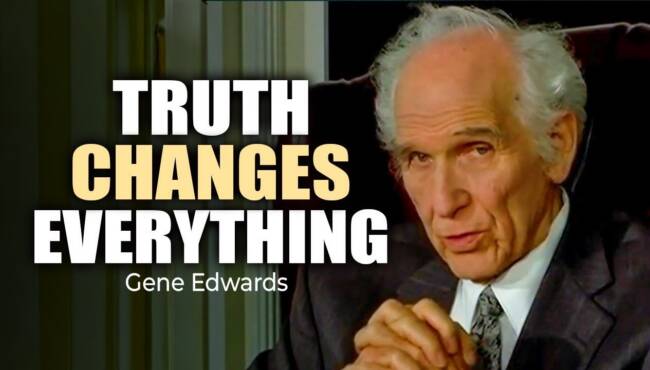
Truth Changes Everything • Jan 01, 2014


See the Real Christ • Feb 01st 1994
What does it truly mean to know Jesus Christ? Beyond doctrine, Bible study, and religious practice lies something far deeper—a revelation of Christ that transforms a believer from the inside out. This teaching invites you into a journey that does not begin with rules, methods, or even information, but with Christ Himself.
Rooted in decades of spiritual searching and prayer, this message explores Jesus Christ not merely as the historical figure who walked the streets of Galilee, but as the eternal Son who existed before creation itself. It challenges conventional starting points in Christian teaching and invites believers to encounter Christ as revealed by the Holy Spirit—not learned, imitated, or systematized.
This is not about acquiring knowledge. It is about seeing Him.
If I start off talking to you about a carpenter, you’ll see a carpenter. If I talk to you about someone walking down the streets of Galilee – the lanes of Galilee – you’ll see a carpenter going down the lanes of Galilee. But if I give you the Creator of this universe, and then I tell you that He walked down the streets of Galilee, I see something totally different. I don’t want to introduce you to the Christ of Judea and Galilee. I want to introduce you to the real Christ.
That He was real—excuse me. For you theologians, come on, give me a little slack here, fellas. When I say the “real Christ,” I mean the Christ that preceded creation and the Christ that preceded the Bible. And I want to give you the Christ that came after the Bible. Now Pilu, I give you an assignment: from now to the day you die, read the New Testament and try to find that Christ. And when you do, remember it.
As the most important thing you’re reading in the New Testament. But here’s something else I want you to do all the rest of your life: and that is, when that carpenter—when that carpenter lets out a little secret as to just who He really is, stop at it. Stop and look at it. You tell me about your fathers – Moses and Abraham. But I tell you that before Abraham was, Yahweh. Yahweh.
What did the man say? He just pronounced the holiest name of God out loud. Jews don’t pronounce that word. He not only said, “I Am”—He said the holiest name of God. And referred to Himself. He didn’t just say, “I am.” He said, “Lord.” But the word “Lord” meant, “I Am.” And the word “I Am” means Lord. In other words, the word “Yahweh” – that’s God.
He said two things at once. Shucks, He said three things at once. He said, “I’m God.” He said, “Before Abraham was—I was?” No. “Before Abraham was—I used to be?” No. “Before Abraham was—I existed?” No. He said, “Before Abraham was…” “Before Abraham was… before Abraham is… before Abraham used to be… from beginning to end—I Am.” I’m not “I Am” over here, but “I Am—I Am everywhere.” He leaked out a secret. “I Am.”
And people, that’s where you have to stop—right there—and you have to say, “I can’t go any further right now. I gotta look at that.” That’s the Christ. That’s Yahweh. And when He says “Where I am, you cannot come…” When they look at Him and He says—they say, “Well, You are sitting here in the temple, and I am sitting here in the temple. What do You mean, ‘Where You are, I cannot come’?” Tim, He wasn’t in the temple. He was in the eternals. He really is “I Am.” “Where I Am, you cannot come.” And then the Lord Jesus later said to the disciples, “I told you I would go and prepare a place for you, that where I Am, you may come and be there too.”
By the way, I want you to accept that as a fact—that He went to this place where He said, “I Am”—and then He invited you to come.
So when you read the Gospels, Pilu, keep looking for these little things. They are there. And if you’re not very careful, Brother Pilu, you’ll get all involved in the Gospels thinking, “This is what God wants me to do. This is what I can’t do. This is what I should do.” Look for Christ. Don’t look for what He’s demanding of you. Look for Jesus Christ. Now, when you get through with the Gospels, go to the epistles and find the Christ who was, who is, and shall be—and He’s all that at once.
Now, I’m going to throw it open to you—and I know you brothers are a little bit intimidated by this camera. We’ve got to stop being intimidated by this camera. Can you think of any reference in the New Testament—not in the Gospels, but in the Epistles—that give you some small, slight glimpse of who He really is? His greatness. Who He is.
Okay—and you get a moment, and you look at that, and you say, “That’s a carpenter?” All things exist by Him, for Him, through Him, to Him. We can add “in Him,” “by Him.” Oh, you can just use up all of those. If those are adjectives… What are those words? By, for, through? You don’t know any grammar either. What is it? Adverbs? Yeah, they’re describing actions. They’re adverbs. All those wonderful adverbs. Okay. Do you know another one? Anybody? All right.
How about this one? In Ephesians 1, there is a reference to a dispensation of an age when all things will be summed up in Christ. I’d like for you to know that every word in the book of Ephesians, you’re going to have to imagine the book of Ephesians as a circle, rather than as a line. And all of the book of Ephesians is around that sentence—that we move toward an economy, a dispensation, a day when all things are summed up in Christ.
Truth Changes Everything • Jan 01, 2014

Free to Fellowship with Christ • Dec 07, 2013
Sow to the Spirit • Nov 23, 2013